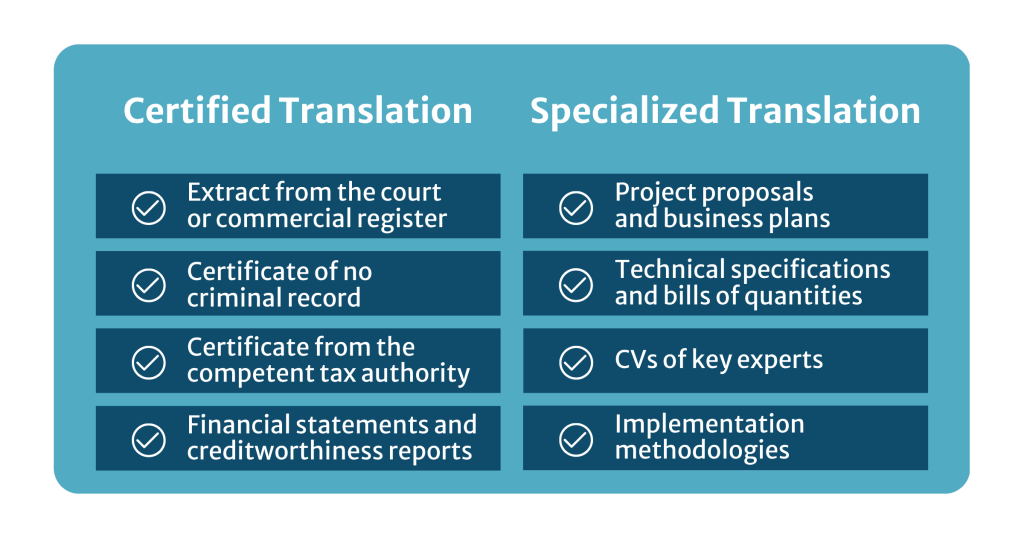
Applying for public tenders and EU-funded projects in Croatia requires a clear distinction between administrative and project documentation. To establish the legal and financial capacity of foreign bidders, Croatian contracting authorities usually require a certified translation by a permanent court interpreter for Croatian. Technical specifications and work methodologies generally require a specialized translation.
The absence of an official seal on legal documentation is a common reason for disqualifying foreign companies from Croatian tenders.
Documents That Most Often Require Certification
Croatian contracting authorities use certified translations to ensure the legal validity of information about a foreign company. Under Croatia’s Regulations on Permanent Court Interpreters, only an authorized court interpreter can use their seal and signature to attest that the Croatian translation fully corresponds to the original document issued in your home country.
Foreign companies bidding for tenders in Croatia usually need to submit certified translations of the following official documents:
- An extract from the court or commercial register in their home country (establishing the company’s legal status, incorporation and ownership structure)
- A certificate from the competent tax authority (official proof that there are no outstanding tax debts)
- A certificate of no criminal record (usually required separately for the legal entity and all individuals authorized to represent it)
- Financial statements and creditworthiness reports (balance sheets, income statements and audit reports)
- Bank guarantees and letters of intent (bid and performance security)
Project Documentation for Which a Specialized Translation Is Sufficient
The content of the bid itself does not require certification by a court interpreter. However, its specific terminology calls for an accurate specialized translation into Croatian. This category includes:
- Project proposals (application forms) and business plans
- Technical specifications, bills of quantities and construction or mechanical engineering drawings
- CVs of key experts, usually in Europass format
- Feasibility studies and implementation methodologies
Important Note: Always Check the Tender Requirements
Although documents are generally categorized and certified as outlined above, a translation agency cannot guarantee in advance which type of translation will be required. Requirements vary considerably depending on the institution issuing the tender. Such as individual ministries or agencies like SAFU or HAMAG-BICRO, and the specific tender rules.
Before sending your documents for translation, always check the procurement documents or contact the contracting authority directly. Confirm which documents require a court interpreter’s seal and which can be submitted as specialized translations without certification.
Legal Framework and Authentication Requirements (Apostille)
Croatia’s public procurement system is strictly regulated by the Public Procurement Act (Official Gazette Nos. 120/16 and 114/22), which is aligned with EU Directive 2014/24/EU. The Act clearly establishes the obligation to demonstrate capacity through official certificates and sets out grounds for excluding bidders whose documentation is uncertified or incomplete.
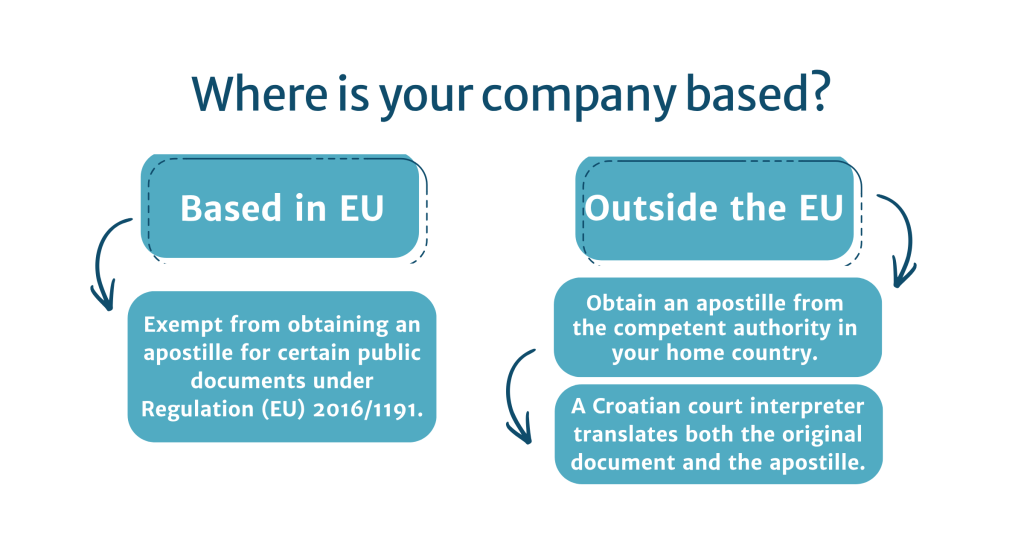
When submitting documents in Croatia, whether your company is based within or outside the European Union is particularly important for document authentication:
For companies based in the EU: Under Regulation (EU) 2016/1191, businesses are exempt from obtaining an apostille for certain public documents, such as certificates of no criminal record, when bidding for tenders in other member states, including Croatia.
For companies based outside the EU: If your company is based outside the European Union, an additional step is required. You must check the document authentication rules in your home country. Your original document must first receive an apostille from the competent court or authority in that country. Once the document has been authenticated, a Croatian court interpreter translates both the underlying document and the apostille into Croatian.
Planning Timelines and Rush Translations
Tender documentation often comprises hundreds of pages of specialized, legal and technical content. Given this volume, it is essential to arrange professional translation well in advance to ensure the highest possible quality and terminological accuracy.
Preparing a bid leaves no room for missteps. If deadlines are approaching and you find yourself short on time, we offer a rush translation service. Send us your tender documentation and, within 30 minutes, we will provide a no-obligation quote and a detailed timeline for translation and certification.