Do you consider Online Travel Agency commissions of 15% to 30% an unavoidable cost of doing business in tourism? For many hoteliers and private accommodation providers, platforms like Booking.com are a double-edged sword, they drive occupancy but, in the long run, eat into profit margins. The solution is not shutting down OTA profiles, but strengthening your own digital channels. This is where professional translation comes in as a strategic tool. Investing in expert linguistic localization of your website directly redirects foreign guests to your domain, reduces acquisition costs and increases net revenue.
Why Do Guests Find Your Hotel on Google but Book Through Booking.com?
Guests book through OTA platforms because they offer clear information, cancellation policies and payment processes in the customer’s language. If a hotel’s official website lacks a high-quality translation, visitors lose trust and switch to Booking.com instead. A precise translation keeps the guest on your site and increases the chances of a direct booking.
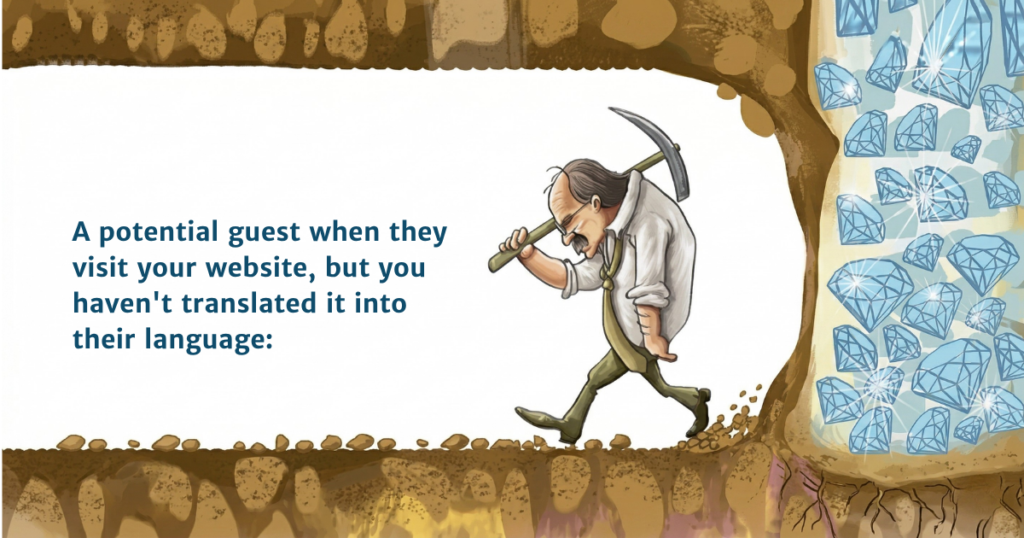
This is not a coincidence, but a well-documented psychological barrier. According to a large-scale global study by CSA Research, as many as 75% of consumers prefer to make purchasing decisions in their native language.
If your website “speaks” only English, a potential guest from Germany may feel uncertain. Booking.com removes that uncertainty by offering flawless content in German. Your task is to eliminate that advantage by implementing accurate, multilingual content on your own domain.
The Hidden ROI: OTA Commissions vs. Professional Translation
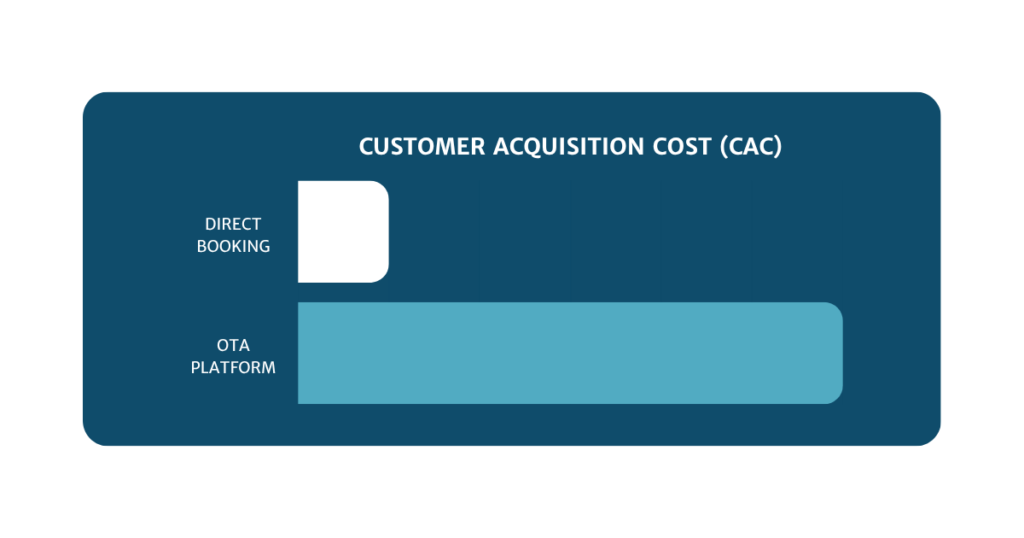
According to industry data cited by Zuzu Hospitality, the customer acquisition cost (CAC) for direct bookings ranges from just 2% to 5%, while OTA platforms take up to 30%.
The key difference lies in the nature of the cost:
- OTA commissions are linear and recurring: every new booking continues to cost you around 20% of the revenue.
- Translation is a one-time investment: you pay once for professional translation and localization. Once your website communicates value in German, Italian or Polish, every future direct booking keeps the full profit margin within your business.
| Booking Channel | Total Booking Value (Gross) | Customer Acquisition Cost (Commission) | Net Revenue for Hotelier |
| OTA platform (20%) | 20,000 EUR | 4,000 EUR (recurring variable cost) | 16,000 EUR |
| Direct – localized website | 20,000 EUR | 0 EUR (no intermediary) | 20,000 EUR * |
*Note: The direct channel requires a fixed, one-time investment in professional translation and SEO, after which you retain the full value of every future booking.
Case Study: How Analytics Turn “Lost” Visitors Into Customers
The real impact of language localization is most visible in the analysis of unconverted traffic. A great example comes from Hospitality Net in a case study by Exely.
A hotel was receiving a significant volume of organic traffic from a country that was not initially a priority market. Despite strong interest, the conversion rate was almost nonexistent, and the bounce rate was extremely high. The reason? The website was not translated into the users’ language.
After the hotel management decided to translate key landing pages and localize the offer for that specific language, the previously lost traffic was quickly converted into direct revenue. The need for OTA advertising was reduced, and the hotel successfully filled its capacity.
How Proper Translation Turns Your Website Into a Sales Tool
A basic, word-for-word translation is not enough to make international guests feel confident. True localization goes beyond grammatical accuracy – it requires market understanding.
Professional website localization ensures that your offer is culturally adapted, that the tone of communication matches the expectations of the target market, and that tourism terminology is precisely translated. Only this kind of translation builds the trust needed for a guest to book directly – outside familiar platforms.